
Sir John Gilbert (London 1817 - London 1897)
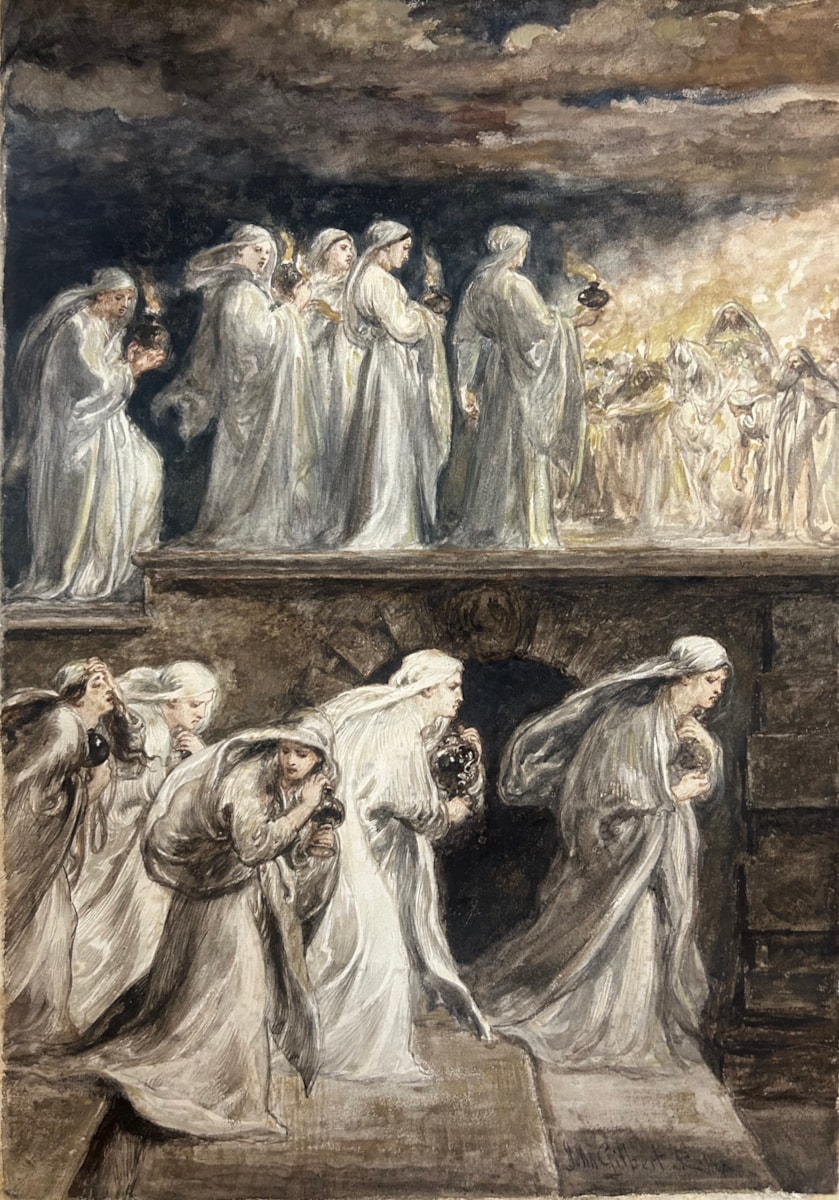
The wise and foolish virgins
Description:
signed, lower right: John Gilbert R.A.
watercolour
505 x 355 mm (image); 540 x 387 mm (sheet)
Provenance:
Private collection, Lincolnshire
Literature
The Academy, vol. 17, issue 401, London, 10 January 1880, p. 34
Spike Bucklow, and Sally Woodcock, eds. Sir John Gilbert: Art and Imagination in the Victorian Age, Farnham, 2011, p. 16 and 257
Exhibitions
Old Watercolour Society winter exhibition, London, 1879
Note:
Sir John Gilbert was an exceptionally prolific Victorian artist, whose posthumous reputation is marked by contradictions. He received substantial professional acclaim during his lifetime, yet has received little attention in posterity, with much of his work remaining unsold before his death. Described as “a conservative painter during an age of extreme radicalism,” Gilbert focused on subjects drawn from English medieval history, literature, legend, and the Bible, aligning himself with what he saw as the enduring values of tradition. He excelled particularly as a watercolourist, as demonstrated in this atmospheric depiction of the Wise and Foolish Virgins. The present work can be compared to a larger piece, Apotheosis of Shakespeare's Characters, from 1871, and also echoes William Blake’s renditions of the same subject from half a century earlier.
The drawing was exhibited at the 1879 Old Watercolour Society (now the Royal Watercolour Society) Winter Exhibition, where Gilbert served as President from 1871 until his death in 1897. The Parable of the Wise and Foolish Virgins is drawn from Matthew 25:1–9, which urges spiritual preparedness: “Then shall the kingdom of heaven be likened unto ten virgins, which took their lamps, and went forth to meet the bridegroom. And five of them were wise, and five were foolish. They that were foolish took their lamps, and took no oil with them. But the wise took oil in their vessels with their lamps.” Divided into two frieze-like planes, similar to classical low-relief sculpture, Gilbert contrasts the two groups of virgins. The virgins below are shrouded in darkness, hunched over and filled with regret. Their lamps are extinguished, and they are set against the black depths of a grotto. In contrast, the virgins above stand upright, their lamps lit as they go to meet the bridegroom, who is shown to the right, bathed in light. The bridegroom’s portrayal was described as “surprising as well as new” in a review of the exhibition published in The Academy in January 1880.
Sold