
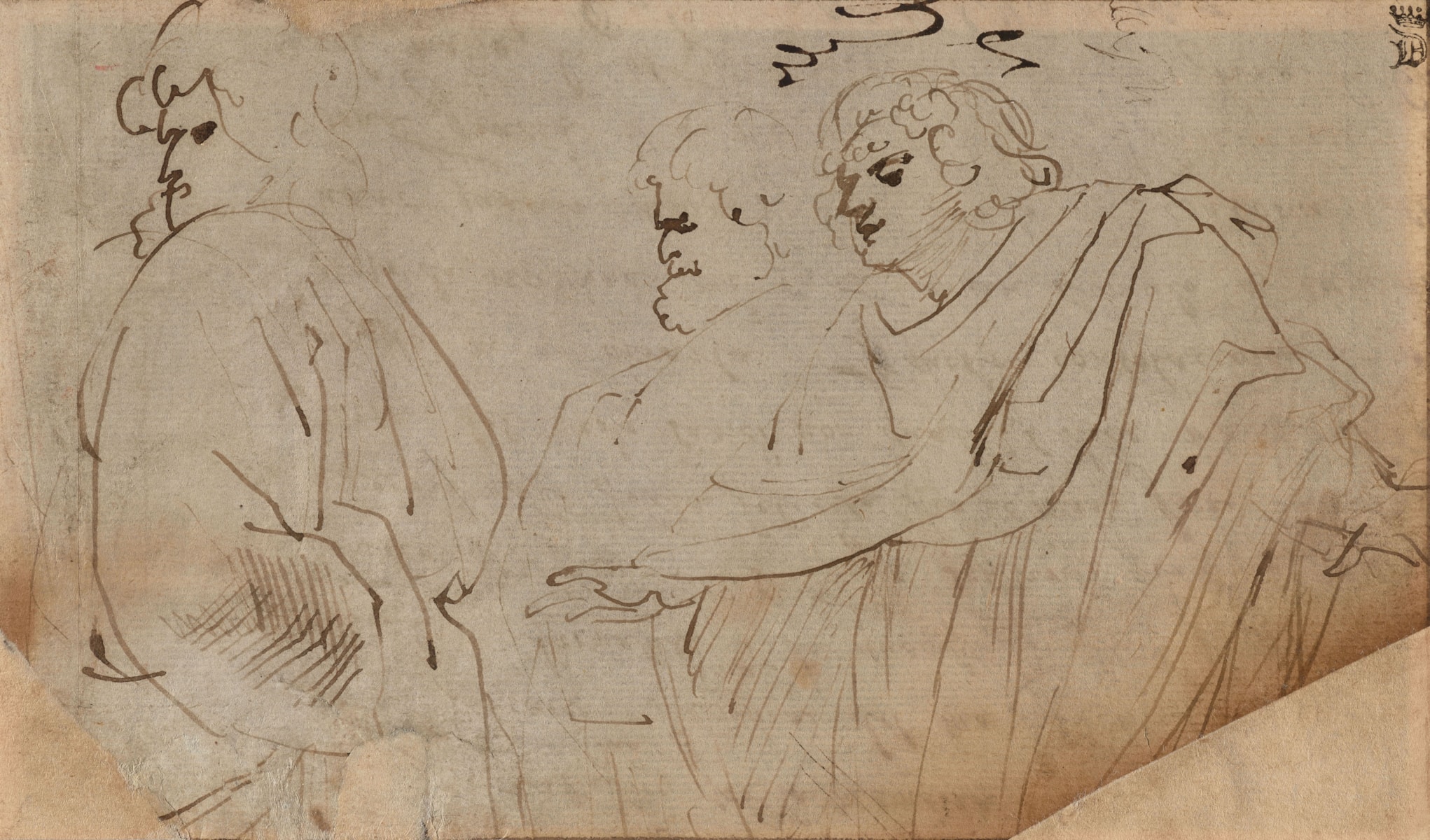
Peter Paul Rubens (Siegen 1577 - Antwerp 1640)
Three figures in classical mantles, probably apostles (recto); a letter to Cristoforo Roncalli, called il Pomarancio (1551/2-1626) (verso)
Description:
letter to Cristoforo Roncalli, called il Pomarancio (1551/2-1626) (verso); dated: Settembre 1607 (verso); inscribed on the mount: apostelen / brief.
pen and brown ink
120 x 200 mm (trimmed at the top, lower corners cut)
Provenance:
The Earls of Dalhousie (L. 717a)
by descent to Arthur George Maule Ramsay, 14th Earl of Dalhousie (1878–1928), Dalhousie Castle
Dr Ludwig Burchard (1886–1960), Berlin and London, 1931
by descent to his son, Wolfgang Burchard (d. 1998), Farnham, Surrey
his sale, Christie’s, New York: 26 January 2011, lot 273
Collections Aristophil, Paris: sale, Artcurial, Paris: 2 April 2019, lot 278
Their sale, Aguttes, Neuilly-sur-Seine: 5 April 2022, lot 278
Where acquired by the present owner
Literature
Ruth Saunders Magurn, ed., The Letters of Peter Paul Rubens, Cambridge, MA, 1955, p. 42
Justus Müller Hofstede, 'Zu den Kunsterwerbungen der Gonzaga in Rom: Ein Brief von Rubens an Cristoforo Roncalli' in Peter Paul Rubens, 1577-1640. I. Rubens in Italien: Gemälde, Ölskizzen, Zeichnungen, exhib. cat., Kunsthalle, Cologne, 1977, pp. 95–9
Carl Van de Velde, 'L'Itinéraire Italien de Rubens', Bulletin de l'Institut Historique Belge de Rome, XLVIII–XLIX, 1978–9, pp. 253–4
Jeremy Wood, Corpus Rubenianum Ludwig Burchard. XXVI: Copies and Adaptations from Renaissance and Earlier Artists. Italian Artists I: Raphael and his School, London, 2010, p. 118
Anne-Marie Logan, ‘New York Auctions at Christie’s and Sotheby’s. 26–28 January 2011’, The Rubenianum Quarterly, 2011, I, p. 5
Raffaella Morselli, Tra Fiandre e Italia: Rubens 1600–1609: regesto biografico-critico, Rome, 2018, pp. 279–280
Anne-Marie Logan and Kristin Lohse Belkin, The Drawings of Peter Paul Rubens, A Critical Catalogue, Volume III, 1621–1640, Turnhout, 2025, pp. 250–251, no. A5
Elizabeth McGrath and Corina Kleinert, in Veronika Korbei et al., Drawings Unrelated to Known Compositions (Corpus Rubenianum Ludwig Burchard, XXVIII), London, 2025, pp. 52–56, figs. 33–34
Exhibitions
Amsterdam, Kunsthandel J. Goudstikker, Catalogus der Rubens-Tentoonstelling, Ten Bate Van de Vereeniging "Rembrandt" in de Zalen van den Kunsthandel J. Goudstikker N.V., 1933, no. 83
Note:
In 1600, Peter Paul Rubens, a promising yet unproven artist, left Flanders for the Italian peninsula where he would spend the following eight years. He travelled firstly to Venice, before settling in Mantua where he was employed at the court of Vincezo I Gonzaga, Duke of Mantua. With Gonzaga’s support, Rubens spent time in Rome, Genoa and Valladolid in Spain, and from late 1605 until late 1608 he acted as the duke’s agent in Rome sourcing art for the ducal collections. This double-sided sheet, with a confident and laconic study of three figures on the recto and a letter dated to September 1607 on the verso, attests both to Rubens’ growing confidence in his graphic skill and to his courtly role with the Gonzaga. The verso contains a fragmentary draft of a letter which does not survive, used to rehearse Rubens’ wording. The letter consists of a courteous message to a painter who is carrying out a commission for the Duchess of Mantua, Eleonora de' Medici. The intended recipient has been convincingly identified Cristoforo Roncalli, il Pomarancio (1551/2–1626), with whom Rubens was close at the time, as attested by his surviving correspondence with Annibale Chieppio (1563–1623), Duke Vincenzo Gonzaga's secretary of state in Mantua. Pomarancio had been commissioned to paint a work for the private chapel of the duchess, and the negotiations proved to be Rubens’ final assignment from the Gonzaga, precipitating the souring of relations and his return to Flanders.
As with the majority of Rubens’ early drawings, the recto of the sheet cannot be linked to any known composition by the artist, although the classical mantles of the figures suggest that they are apostles. McGrath and Kleinert have recently identified the man with open arms as John the Evangelist, noting the resemblance of his features with those of the same saint from Rubens’ Apostle series, now at the Museo del Prado. An interpretation of the subject has proved equally problematic, with the Assumption, the Death of the Virgin, and the Beautiful Gate of the Temple all tentatively proposed. With less conviction, the drawing has also been interpretated as a recording of a painting seen in Rome or Mantua, possibly the Roncalli painting mentioned in the letter. While Rubens dismissed his contemporaries in Spain as showing ‘incredible incompetence and carelessness’, he held a handful of Italian painters in high esteem, including Federico Zuccaro (15401/1–1609), Annibale Carracci (1560–1609) and Caravaggio (1571–1610), and he venerated the painters of the High Renaissance, in particular Michelangelo (1475–1564), Raphael (1483–1520) and Giulio Romano (1499–1546). In just a few lines, Rubens assuredly formed the figures, gave weight to the drapery and defined the spatial interactions. Julius Held noted the developing skill in Rubens’ late Italian drawings, remarking that ‘incessant drawing from classical sculptures and from the painters of the Renaissance was bearing fruit’. Considering Rubens' interest in Caravaggio, there is an intriguing resemblance in reverse to the composition of the Calling of Saints Peter and Andrew, c. 1602–4, in the Royal Collection.
The letter on the verso has been transcribed and translated as follows:
... among other things, for the memory... / ... (my?) Most Serene Mistress of her painting./ [has] remained very informed of what is due precisely [to] / the supreme value of Your Lordship. I would feel great pleasure [to see] / such a [beautiful?] / work born in your hands with the usual happiness, for the rest I would not be what you say but useless ... / except in admiring it. In this consolation I [am] / certain of receiving it, it will be a great incentive for me to venerate [examine] / it as soon as possible. In the meantime, keep me in [the] / good grace and in that of Mr. Abbate Crescenzi ... / with your help I will be able to deserve it. And finally I kiss your hands ...
As a draft written on the back of a drawing to revise courtly phrasing, the letter was evidently never sent, and a finished version of the letter does not survive. The subject and whereabouts of the painting mentioned are also unknown, yet it is clear that the painting was intended for Eleonora de' Medici, Rubens’ ‘Most Serene Mistress’, and that the artist was anxious to inspect the work personally. In the second half of 1607 Rubens was conducting negotiations in Rome on behalf of the Duchess for the acquisition of the Pomarancio painting, as well as Caravaggio’s monumental Death of the Virgin, and this letter is the sole document from the period. At the same time, Rubens was completing his own altarpiece for the Oratorians at the Chiesa Nuova, for which a broadly comparable drawing is known. Following inspection, Rubens approved the two paintings and succeeded in negotiating reduced prices for Mantua. Shortly thereafter, he discreetly offered his Chiesa Nuova altarpiece to the Duke, but the offer was declined due to lack of funds. Somewhat dejected, Rubens severed ties with Mantua and returned to Flanders not long afterwards.