
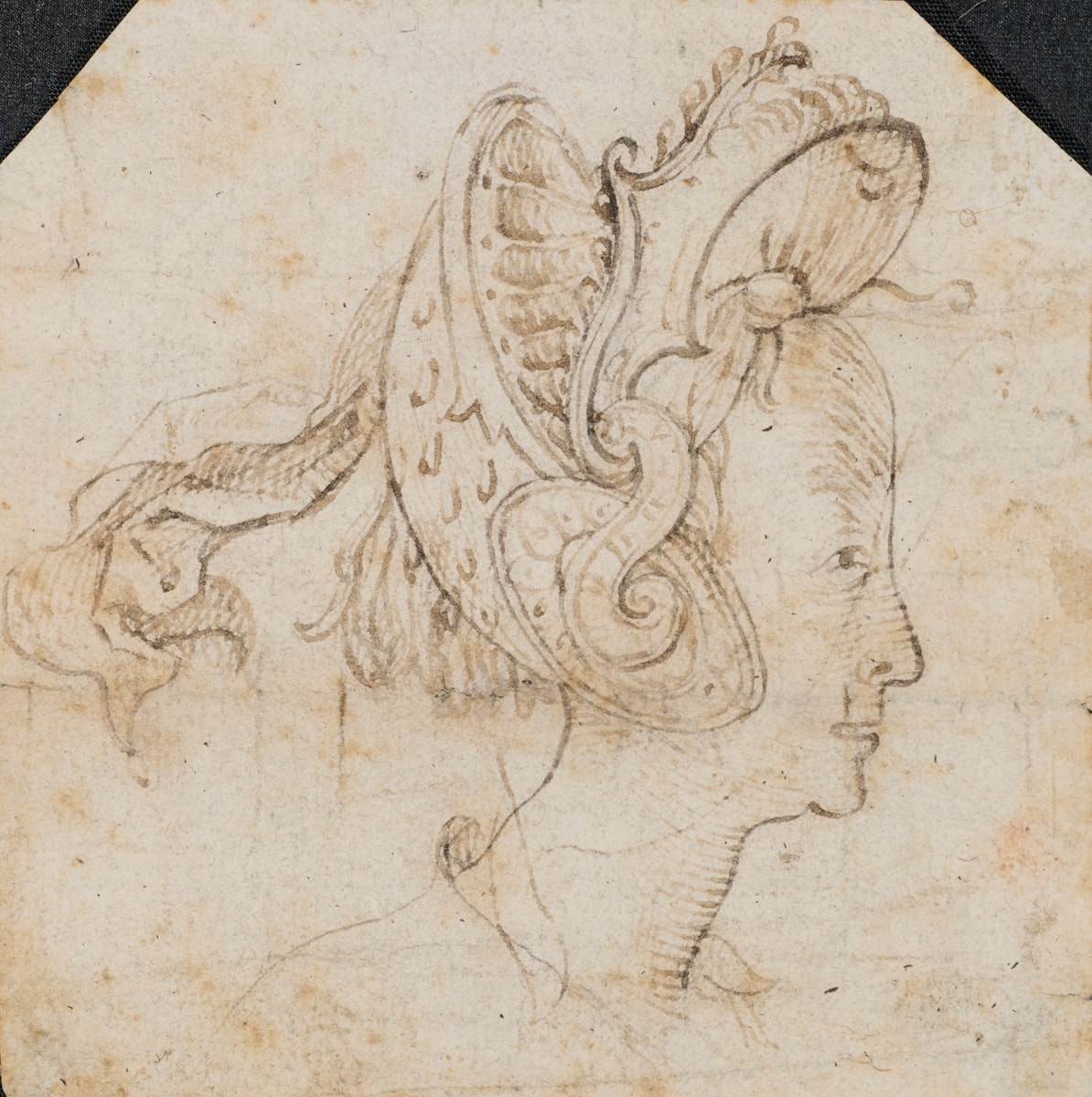
circle of Heinrich Vogtherr the Elder (Dillingen 1490 - Vienna 1556)
The head of a woman in profile to the right, wearing an elaborate helmet (recto); architectural studies (verso)
Description:
pen and brown ink
85 x 82 mm (cut at upper corners)
Provenance:
Private collection, UK
Note:
This fantastical drawing of a female head with an elaborate helmet is related to a group of woodcuts from the first printed model book, published in 1538 by the German artist, doctor, poet and printmaker, Heinrich Vogtherr the Elder. The publication, Ein frembds und wunderbars Kunstbüchlin, is a compendium of motifs, including antique columns, suits of armour and head studies, intended to inspire emulation across various artistic fields, from woodcarving to stonemasonry. With multiple heads arranged on single sheets, Vogtherr’s head studies display extraordinarily inventive headgear, drawing on sources from multiple periods and regions, including antique coins and intaglios, Italian and Netherlandish art. Dated by the watermark to the first half of the sixteenth century, the present drawing is testament to the invention that Vogtherr’s publication inspired and his contemporary influence. Although this composition is unique and demonstrates the unknown artist’s originality, it can be closely compared with the head at upper left of page B.III. The drawing itself is cut from a larger sheet and may be compared with a full sheet preserved at the Universitätsbibliothek Erlangen, Nuremberg.
No comprehensive survey of Vogtherr’s drawings has been undertaken and only a handful of sheets have been attributed to him rendering stylistic comparison problematic. Vogtherr’s woodcuts, on the other hand, have recently been published in their entirety and his influence on not just the decorative arts but on early artistic education has been made apparent. While the Kunstbüchlin presents finished models for direct use in the arts, the inclusion of studies of hands and feet reveals its secondary function as a tool for drawing instruction. Artists such as Virgil Solis (1514–1562) and Peter Paul Rubens (1577–1640) are known to have used the book for study, and comparable images of women wearing fantastical helmets, some of which were directly copied from the Kunstbüchlin, appear among Solis’s engravings from the 1540s.
We are grateful to Giulia Bartrum for her expertise and assistance.
Sold