
Dutch School, 1775–1810
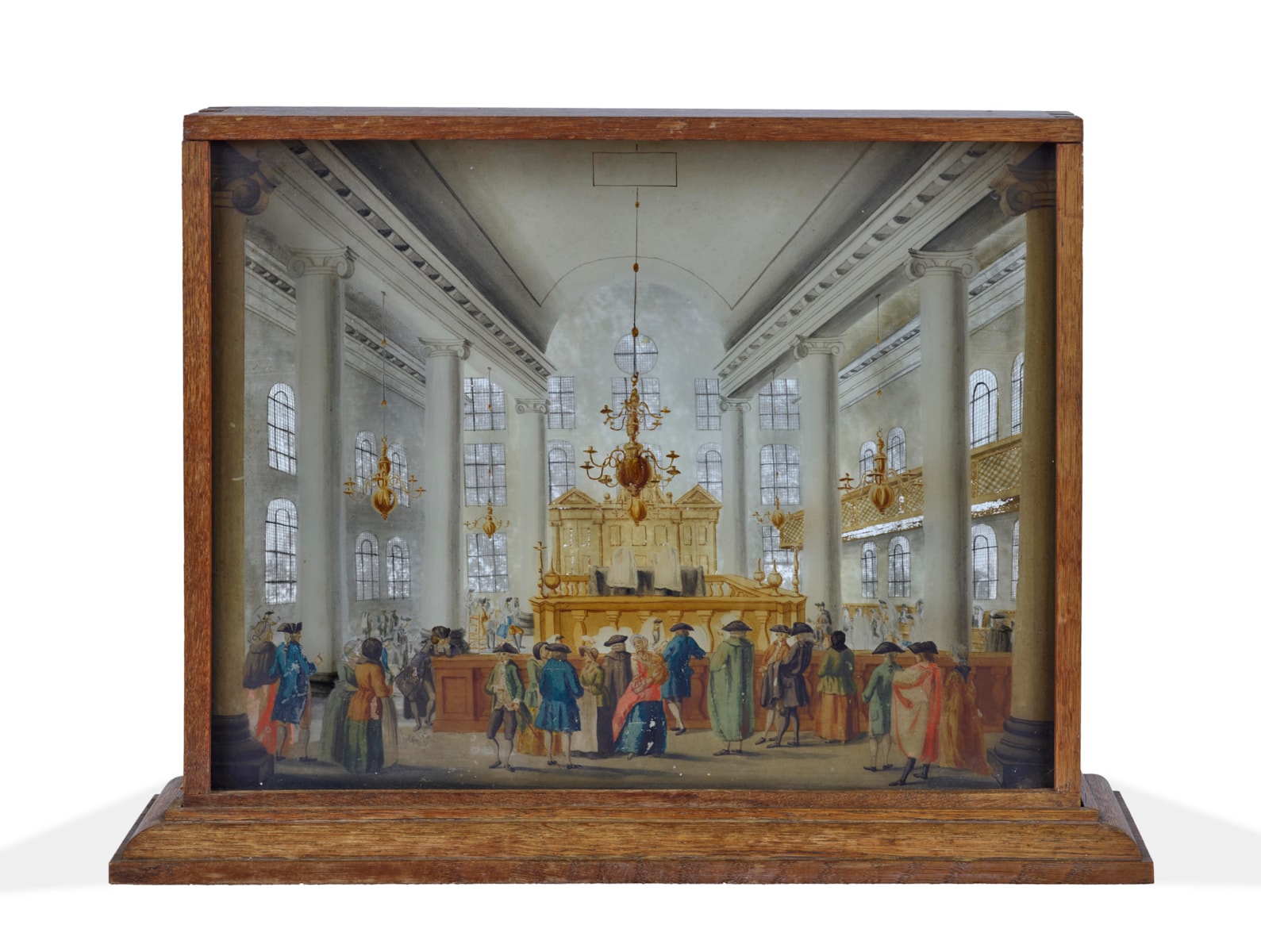
Diafanorama with the feast of Purim at the Portuguese synagogue in Amsterdam
Description:
perspective box made of brown lacquered oak, three glass panes painted in oil
330 (w) x 445 (h) x 130 (d) mm [at largest points]
Provenance:
Private collection, Dorset
Note:
Produced exclusively in the Netherlands during the second half of the eighteenth and early nineteenth centuries, diafanoramas (or diaphanoramas) constituted a popular form of domestic visual entertainment. A significant, but understudied element in the pre-history of cinema, diafanoramas succeeded the seventeenth-century perspective boxes of Samuel van Hoogstraten (1627–1678), and the mid-eighteenth-century miniature card dioramas of Martin Engelbrecht (1684–1756), and prefigured Louis Daguerre’s (1787–1851) life-size dioramas. Their fragility, however, has resulted in a very limited survival rate – only around 120 examples are known today. Formed of three sheets of cold painted glass encased within an oak box, this unique survival depicts the feast of Purim – the annual celebration of the salvation of the Jewish people from the massacre plotted by the Achaemenid official Haman – at the Portuguese Synagogue in Amsterdam. Completed in 1675, the synagogue was once the largest in the world and it remains both an active place of worship and a major cultural landmark.
Diafanoramas were typically modelled after prints and drawings, and this hitherto unpublished example relates to Bernard Picart (1673–1733) and Jean Frederic Bernard’s (1683–1744) celebrated Cérémonies et coutumes religieuses de tous les peuples du monde. Originally published in Amsterdam in seven volumes between 1723 and 1737, this influential encyclopaedia of religious customs was swiftly republished overseas and translated into multiple languages. Volume I describes the religious customs of Catholics and Jews, and the French edition of 1741 includes an engraving captioned La fête de Purim, a collaboration between two of Picart’s pupils: Louis Fabricius Dubourg and Bernard Bernaerts. During the 1750s, this engraving was widely copied and reproduced, with examples published in Paris by Jacques Chéreau, Jacques-Gabriel Huquier and the Basset family, and in London by William Forrest. These prints provided the model for the maker of this diafanorama
Please contact us for a full catalogue entry.