
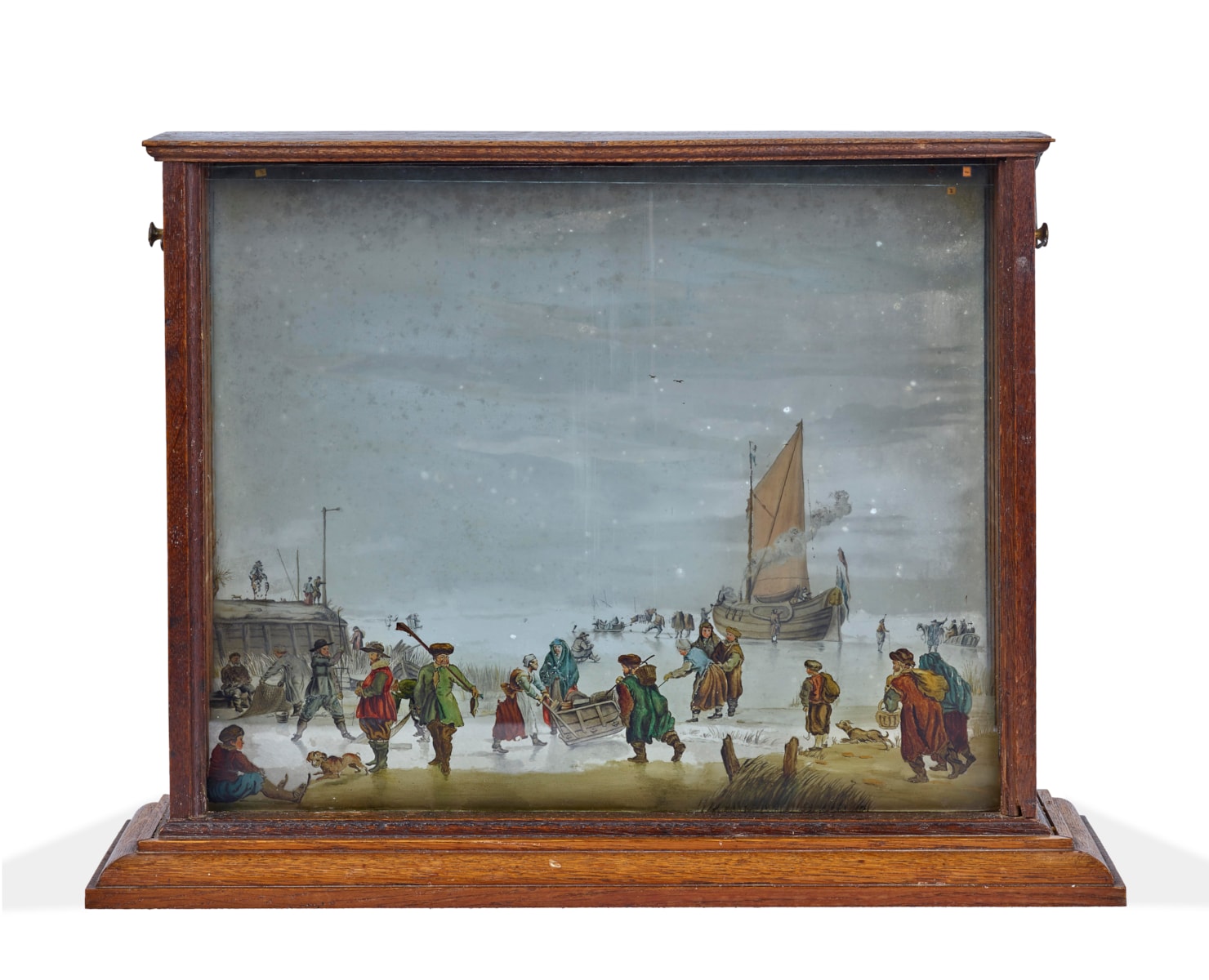
Dutch School, 1775–1810
Diafanorama with skaters and sleighs on the ice near Haarlem
Description:
perspective box made of brown lacquered oak, four glass panes painted in oil
350 (h) x 470 (w) x 145 (d) mm [at largest points]
Provenance:
Private collection, Dorset
Note:
Produced exclusively in the Netherlands during the second half of the eighteenth and early nineteenth centuries, diafanoramas (or diaphanoramas) constituted a popular form of domestic visual entertainment. A significant, but understudied element in the pre-history of cinema, diafanoramas succeeded the seventeenth-century perspective boxes of Samuel van Hoogstraten (1627–1678), and the mid-eighteenth-century miniature card dioramas of Martin Engelbrecht (1684–1756), and prefigured Louis Daguerre’s (1787–1851) life-size dioramas. Their fragility, however, has resulted in a very limited survival rate – only around 120 examples are known today.[1] Comprising four sheets of cold-painted glass housed within an oak box, this exceptionally rare survival depicts skaters, hunters, and sleighs traversing the frozen landscape near Haarlem during the so-called ‘Little Ice Age’, the period of prolonged climatic cooling that affected northern Europe in the seventeenth century.
Diafanoramas were typically modelled after prints and drawings, and this hitherto unpublished example relates to an engraving by Simon Fokke (1712–1784) after a drawing by Hendrick Avercamp (1585–1634), now in a private collection.
Diafanoramas were intended to be viewed in darkened rooms and functioned as a form of refined after-dinner entertainment. Illuminated from behind, typically by a lightbox, and viewed either directly from the front, or in reverse through a concave “burning mirror”, the image was both brightened and optically enlarged. The lightbox, a narrow wooden structure lined with sheet metal, held candles that cast light onto the reverse of the glass. When viewed through the mirror, the reflected image was subtly distorted, enhancing the illusion of depth and, at times, imparting a sense of motion that shifted with the viewer’s position.
Please contact us for a full catalogue entry.