
Lise Lévesque (French, 19th century - )
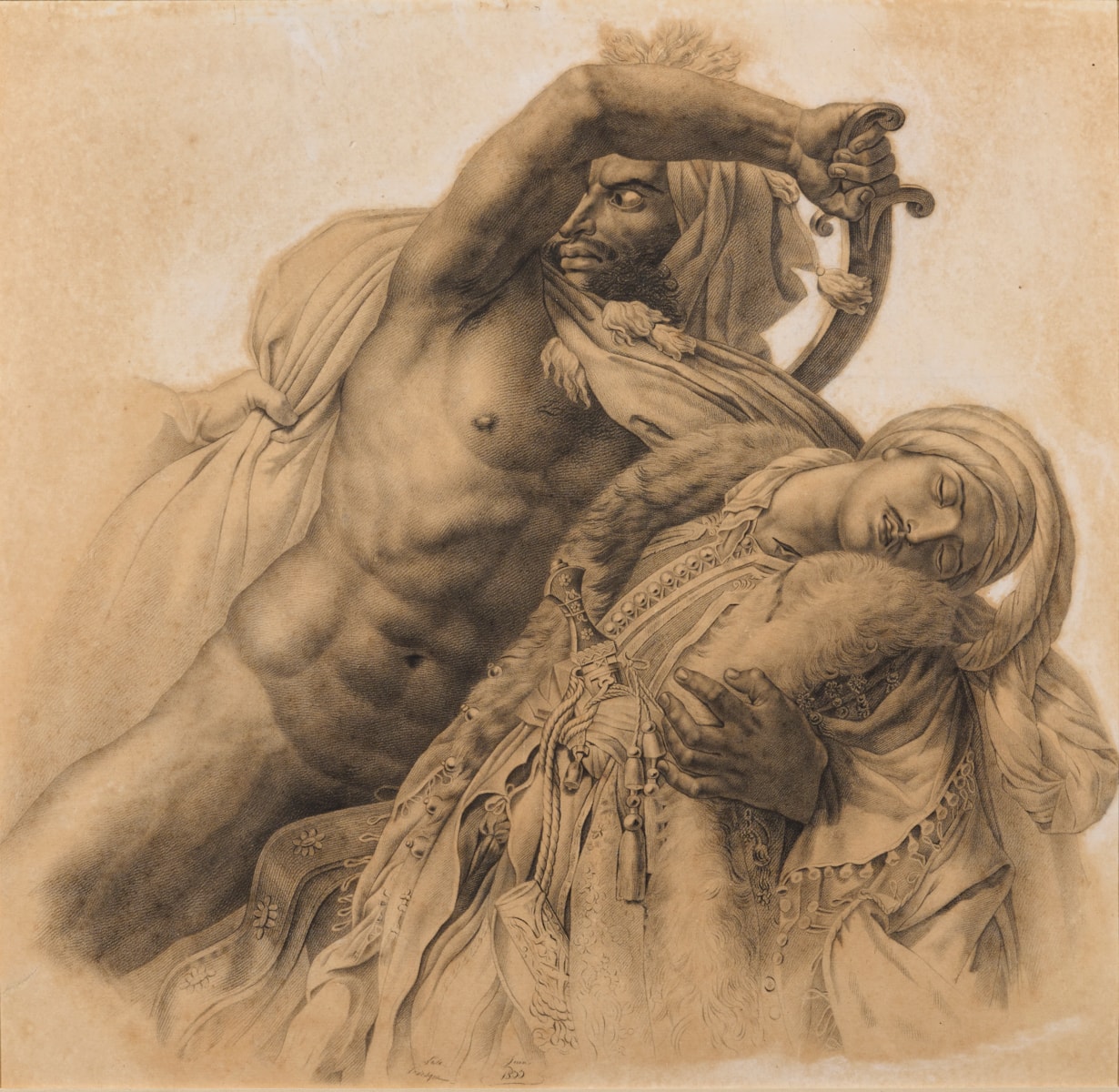
The revolt of Cairo, 21 October 1798
Description:
signed and dated: Lise Lévesque / Juin 1833
black chalk
470 x 485 mm
Provenance:
Private collection, Vienna
where acquired by the present owner, 1990s
Note:
This highly detailed black chalk drawing depicts a Moorish slave-servant defending a wounded Mameluke, an elite member of the Egyptian military class. The scene is drawn from Anne-Louis Girodet’s monumental painting, Révolte du Caire, 21 octobre 1798, which records one of the bloodiest moments of Napoleon’s invasion of Egypt. The painting commemorates the suppression of an uprising at Cairo in October 1798 in a pitched battle fought inside the Al-Azhar mosque. The painting, dated 1810, was commissioned by Napoleon in 1809 for the Galerie de Diane in the Tuileries Palace, and is now at the Musée National du Château de Versailles.
Lévesque’s refined drawing is large in scale and drawn with meticulous precision of line. It is not copied from the painting itself – which was at the Musée du Louvre from 1824 until its transfer to Versailles in 1835 – but from Alexis-François Girard’s engraving of the two figures which was published by Basset in the 1820s after a drawing by Edmé Gratien Parizeau.
The drawing is signed and dated to June 1833, however knowledge of the artist’s life and graphic corpus is minimal beyond the evidence of the sheet. Her dates and place of birth are unknown, and her surviving oeuvre consists of just one further sheet – a monumental copy after Jean Godefroy’s 1808 The death of Hippolytus, an engraving of a drawing by Carle Vernet. Her name and chosen subject matter indicate a French origin and a formal training in an artist’s studio or private academy which followed the French academic system. In these classes students began by copying prints and drawings, before progressing to plaster casts of body parts, then entire figures. In the 1830s however, the final stage of drawing from the nude model was still reserved for male artists. Like many women artists of the period, Lévesque’s talent is unquestionable, yet her full story remains to be discovered.
Sold