
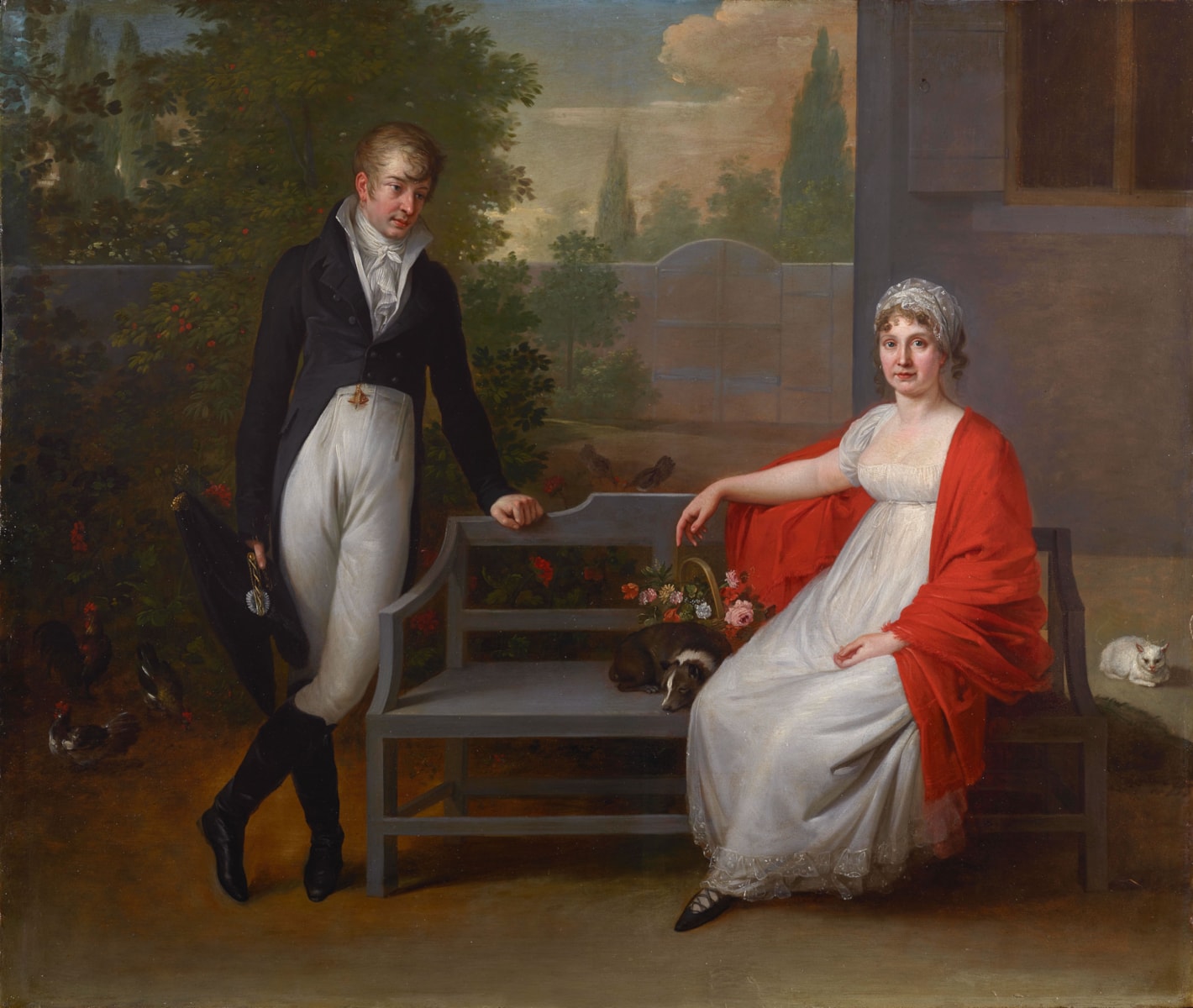
Joseph Hauber (Geratsried, Allgau 1766 - Munich 1834)
A double portrait in a garden
Description:
signed and dated on the bench, centre right: J. Hauber Pinxit. 1809.
oil on copper
76 x 90 cm
Provenance:
Private collection, Munich
Note:
Painted in 1809 by the Bavarian painter and engraver Joseph Hauber, this double portrait depicts a hitherto unidentified bourgeois couple from Munich. Set in a verdant garden before a substantial house, the pair are surrounded by animals and flowering plants: symbols of prosperity and fertility. The woman, dressed in fine silk with a striking red robe and a full, prominent bodice, sits on a bench and meets the viewer’s gaze directly. Her husband leans beside her, resting on the bench and looking toward her. His black bicorne hat, adorned with a distinctive blue-and-white Bavarian cockade, identifies him as a former or inactive officer, or possibly a civil servant of officer rank, signalling loyalty both to his wife and to the Bavarian state, which had recently aligned itself with Napoleonic France.
Joseph Hauber was one of the leading representatives of early 19th century Classicism in Munich. The son of a carpenter, Hauber first trained in Rattenberg under Anton Weiß (1801–1851), before enrolling at the Academy of Fine Arts in Vienna. His abilities were noticed by Elector Karl Theodor who provided him with an annual salary of 200 florins. From 1785 he lived in Munich, and in 1800 he became professor at the Academy of Drawing. When King Max Joseph founded the Munich Academy of Fine Arts in 1808, he was appointed professor and remained in the position until his death in 1834. Having commenced his career primarily as a religious painter, around 1800 Hauber became the preferred portraitist of the Munich nobility and the moneyed bourgeoisie. Maximilian Joseph Baron von Montgelas had himself and his family portrayed by Hauber on several occasions, as did the Electress of Palatinate-Bavaria, Maria Leopoldina, and the Prince-Bishop of Eichstädt. Today, his paintings can be found in the Lenbachhaus, Munich, and the Bayerische Staatsgemäldesammlungen, Munich.