
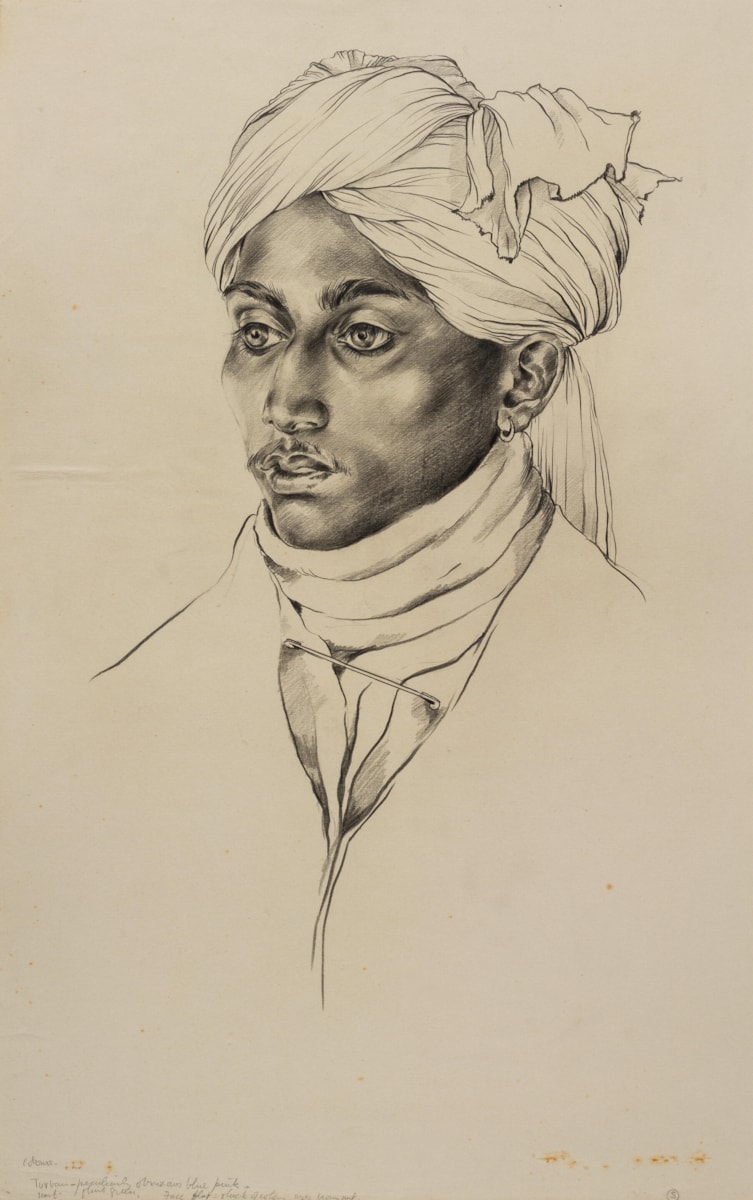
William Collett-Mason (Rosario 1895 - Tunbridge Wells 1957)
A portrait from Northwest India
Description:
Portrait 2
inscribed, lower left (recto): Colours: / Turban - peculiarly obnoxious blue pink./ Scarf - lime green. Face, flat - lack of colour. Eyes [...] (recto); inscribed, lower right (recto): Ex: Paris Salon
pencil and black chalk on paper laid on card
565 x 390 mm (the largest); 725 x 530 (the card)
Provenance:
The artist’s family, until 2025
Exhibitions
Le Salon, 137ème Exposition Officielle, MCMXXIV, Grand-Palais, Paris, 30 April 1924
Note:
This remarkable series of nine portrait drawings provides a window into the lives and costumes of working men in Northwest India before the partition of 1947. Drawn in 1923 by the British artist-traveller, William Collett-Mason, the drawings are located in various cities in Balochistan and Punjab, regions that now form part of Pakistan but were then within British-ruled India. The sitters are identified, located, and described by the artist’s inscriptions, which note some of their occupations – soldiers and charcoal burners – their physical characteristics, and their personalities. One sitter, for example, is described as a “dandyish young man wearing a pink through his stock and an earring” [2]. His name is recorded as Dumah Khan (Rhau), while another man is identified as Pier marmuud (Pir Mahmood) [9]. The individual character of each sitter is expressed through unique poses and a varied graphic technique, with some sheets heightened in watercolour, others finished in bicolour.
In 1923, Balochistan was inhabited by several tribes and peoples including the Balochi, the Brahui and the Pasthun and this diversity is reflected in the rank and social caste of the sitters. While dress varies from a scalloped-edged shirt [1] to a soldier’s greatcoat [6], all sitters wear a variation of the turban, the traditional headdress of India, known as the paag in Balochi and the dastaar in Brahui. Today turbans are frequently associated with Sikh identity, although they were commonly worn by Hindus and Muslims at the time. The 1921 Indian census recorded a 92% Muslim population in Balochistan, and a 60% Muslim population in Jhelum, northern Punjab. It is therefore likely that most of the sitters are in fact Muslim, an assumption supported by their cropped hair and short beards. In the British Indian Army, the wearing of the turban became mandatory for all soldiers following the Indian Rebellion of 1857, and it was worn in various colours and styles. As seen in the portrait of Pier marmuud [9], Muslim soldiers could be distinguished by their khulla, a cone-shaped cap around which the pagri (the principal cloth of the turban) was wrapped.
The drawings of a man in a turban and scarf [5], and a charcoal burner [8] were drawn in Quetta, the capital of Balochistan, while a third drawing of a bearded man in profile was made in Dalbandin, western Balochistan [7]. The drawing of Pier marmuud, a soldier with a cap badge in his turban, was made in Jhelum [9]. From May 1921, Jhelum hosted the 10th Battalion of the newly reorganised 1st Punjab Regiment, and the sitter may be plausibly identified as the Pir Muhammad Khan recorded as a Jamadar (junior commissioned officer) in the Indian Army List of April 1923. Pir Muhammad Khan entered service on 1 December 1902, and is described as ‘Ind. Qr. Mr.’ (Indian Quartermaster). The other named sitter, Dumah Khan, could not be traced.
Please contact us for a full catalogue entry.