
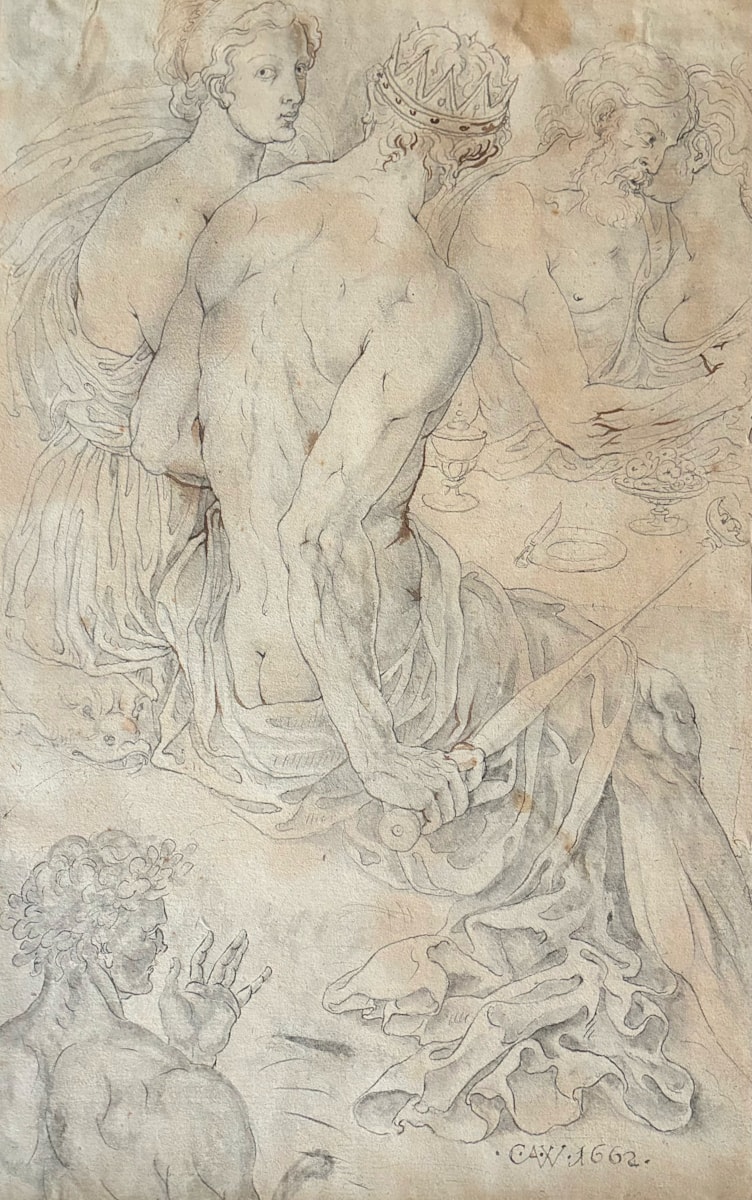
Christopher Abraham Walther (Dresden c. 1625 - Dresden 1680)
The banquet of the gods
Description:
monogrammed and dated, lower right (recto): CAW 1662; unidentified collector’s mark, lower right (verso); stamped, lower left (verso): BAVARIA
pen and black and brown ink and grey wash
315 x 200 mm
Provenance:
Probably Heinrich Lempertz Senior (1816–1898), Cologne
Probably his sale, J.M. Heberle (H. Lempertz Söhne), Cologne: 18–23 June 1900, lot 1217 (as Christian Cawenbergh)
Private collection, France
Literature
Probably Horst Vey, "Kölner Zeichnungen aus dem 16., 17. und 18 Jahrhundert: Eduard Trautscholdt zum 70. Geburtstag", Wallraf-Richartz-Jahrbuch, Vol. XXVII, 1965, p. 404.
Probably Lise Lotte Möller, "Einige neue Zeichnungen des Dresdener Bildhauers Christoph Abraham Walther", Jahrbuch der Hamburger Kunstsammlungen, Vol. 16, 1971, p. 91, no. 1662.
Note:
Drawings by the Dresden sculptor Christoph Abraham Walther are exceptionally rare, his entire graphic oeuvre comprising fewer than twenty known sheets. A small group of drawings unified by the "CAW[B]" monogram was first assembled by Horst Vey in 1964 and tentatively attributed to an unknown member of the Couwenbergh dynasty. Werner Schade has since convincingly identified the monogram as that of Walther and several further drawings have been added to the initial group by Vey, Schade, and Lise Lotte Möller, while a final drawing appeared on the London art market in 1993. The present drawing has never been reproduced and is likely the one identified by Vey in 1965 as "Mythologische Gruppe", dated 1602 and originating from the collection of Heinrich Lempertz Senior which was auctioned at J.M. Heberle in June 1900.
The drawing belongs to a group of studies after prints made in 1661–62, a period during which Walther’s sculptural business may have been in flux. Executed in pen and ink with wash to accentuate musculature, shadow, and the folds of drapery, the drawing depicts a mythological banquet, likely a fragment of a larger composition representing the marriage of Peleus and Thetis, often known as the Banquet of the Gods. Scenes of Olympian deities dining around a table were popular in seventeenth-century Flanders, with numerous examples by artists including Jan Brueghel the Elder, Hendrick van Balen, and Peter Paul Rubens circulating in print. Although Walther’s precise source remains unidentified, Rubens appears to have been a favoured model. A monogrammed partial copy after Willem van der Leeuw’s engraving after Rubens’ Daniel in the Lion’s Den (1661) was formerly on the Dresden art market, while a further partial copy after Paulus Pontius’ engraving after Rubens’ Massacre of the Innocents (1661) is preserved in the Staatliche Graphische Sammlung, Munich. In each case, Walther isolates sections of a full composition, largely suppressing their original setting.
Please contact us for a full catalogue entry.