
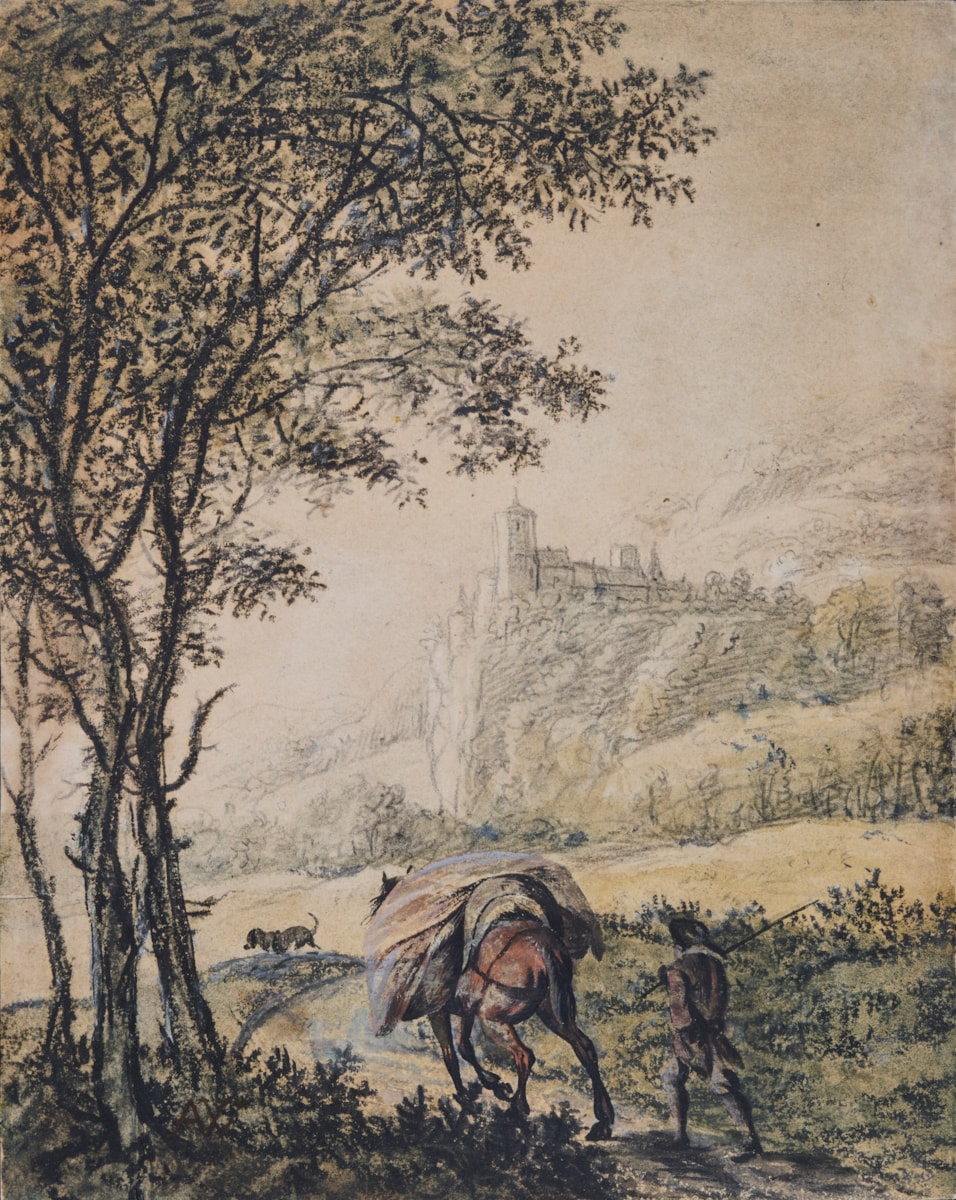
Anthonie Waterloo (Lille c. 1609 - Utrecht 1690)
Landscape with a man, horse and dog, a town beyond
Description:
monogrammed, lower left: AW; inscribed on backing sheet: Turnpenny
oiled black chalk, bodycolour and watercolour
258 x 198 mm
Provenance:
Possibly Captain Joseph Turnpenny (c. 1739 – c. 1829), Dover and Leasowes
Major Addison Francis Baker-Cresswell (1874–1921), Northumberland; given by him to
Dorothy Winkworth, Northumberland; by descent to her daughter
Mrs G.W. Wrangham, née Mary Winkworth (c. 1903–1933), Northumberland; by descent to her son,
Edward Addison Wrangham (1928–2009), Northumberland; by descent to his wife,
Anne Wrangham (1933–2025), Northumberland
Literature
Karl. T. Parker, "Some Drawings by Rubens and his School in the Collection of Mrs G.W. Wrangham", Old Master Drawings, June 1928, p. 1.
Note:
Described as a “particularly attractive landscape” by Karl T. Parker, this atmospheric drawing by the Dutch draughtsman and printmaker Anthonie Waterloo belongs to a small group of sheets with idiosyncratically formed figures. The drawing has a pendant at the Musée Condé, Chantilly, which is comparable in size, atmosphere, and compositional structure. The two sheets display mirrored arrangements that suggest they were conceived as a pair. In both compositions, a pastoral figure carrying a staff or gun advances toward the centre of the scene accompanied by animals. While a single dominant tree frames one side of the composition, an expansive wooded landscape with distant settlements occupies the other. The angular handling of the figures, heightened with touches of red, further reinforces the relationship between the sheets.
In both drawings, it has been suggested that the staffage was added by another hand; Jan Baptist Weenix was once proposed for the Chantilly drawing. Recent scholarship, however, has rejected this hypothesis and reaffirmed the autograph nature of the figures, citing comparisons with a drawing in the Albertina, Vienna, containing similar staffage.
Little is known of Waterloo’s early life, and the absence of documentary evidence for formal training has led some scholars to suggest that he may have been self-taught. If so, this may account for his highly individual technique and experimental use of media. Waterloo frequently combined chalk, watercolour, bodycolour, gouache, and even charcoal soaked in linseed oil to achieve richly atmospheric effects. In the present sheet, varying tones of watercolour and bodycolour are combined with both dry and oiled black chalk. The densely foliated tree was first detailed in oiled black chalk and subsequently heightened with green watercolour and white bodycolour, while the distant town and landscape were rapidly indicated in black chalk and strengthened with ochre and green watercolours. The figure and horse were drawn in oiled black chalk and heightened with red and white bodycolour.
Please contact us for a full catalogue entry.