
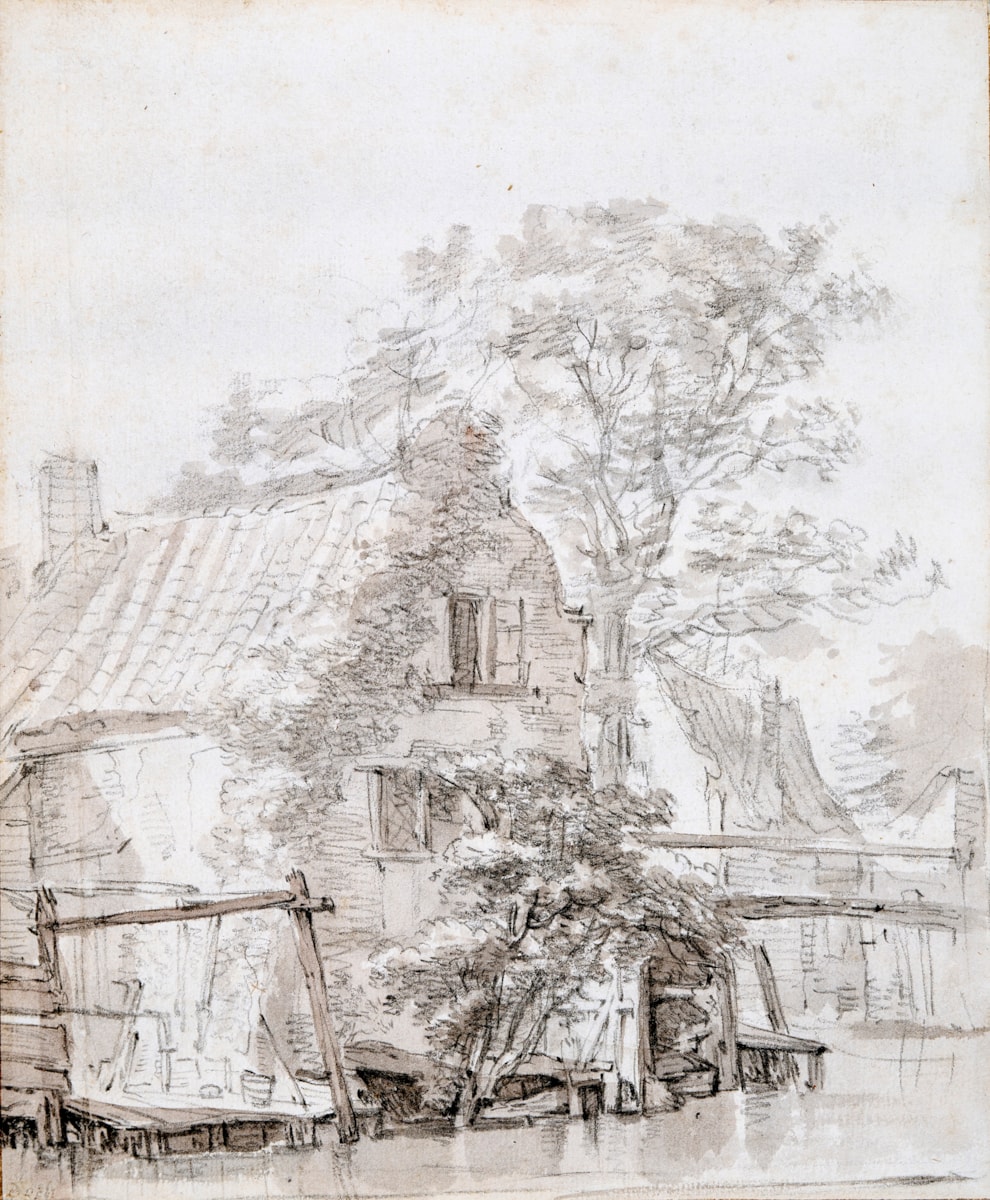
Roelant Roghman (Amsteradm 1627 - Amsterdam 1692)
Houses and a tree by the water near a bridge
Description:
inscribed, lower left (recto): Both; inscribed on backing sheet: Roghman
brown and grey wash over black chalk
206 x 172 mm
Provenance:
Hendrikus Egbertus Ten Cate (1868–1955), Almelo [L.533b]
C.G. Boerner, Düsseldorf, 1964
Christie’s, New York: 25 January 2005, lot 192 (as Emanuel Murant)
Private collection, Rye, New York
Literature
C.G. Boerner, Düsseldorf, 150 Meisterzeichnungen des 16. Bis 19. Jahrhunderts, 1–15 December 1964, no. 93 (as Herman Saftleven).
Peter Schatborn, Rembrandt and his Circle. Drawings from the Frits Lugt Collection, 2 vols., (Bussum: Thoth; Paris: Fondation Custodia, 2010), vol. II, pp. 360–361, under no. 154, fig. 77, ill.
Note:
This water-side landscape is one of two versions of a drawing that Peter Schatborn has attributed to Roelant Roghman. The second version, in the Frits Lugt collection at the Fondation Custodia in Paris, is different in several respects, including the larger scale of the drawing, the level of the water and the figures with which the scene is populated. Schatborn suggests that both drawings were done in situ and tentatively dates them to after Roghman’s celebrated castle series in c. 1646–7, and before his journey to the south in 1654–7. In stylistic terms, the present drawing may be compared with sheets at the Museum Boijmans in Rotterdam and a second drawing in the Lugt collection.
The Lugt collection also contains an 18th-century variation of the drawing which is attributed to François Boucher. The Boucher drawing was executed more precisely than either of the two earlier examples, and the artist introduced new details that were only indicated in the other drawings. A weak tributary stream, for example, seen to the right of the wooden platform in the Roghman drawings, is transformed into a more powerful flow in the Boucher sheet, while a secondary stream, seen on the other side of the tree at centre left, is also introduced. The shape of the roof is reworked in the Boucher drawing, and the thin wooden bridge is replaced with a more solid stone arched bridge. The new stone bridge obscures the wooden house further downstream, transforming the Dutch view into something more French.
Please contact us for a full catalogue entry.