
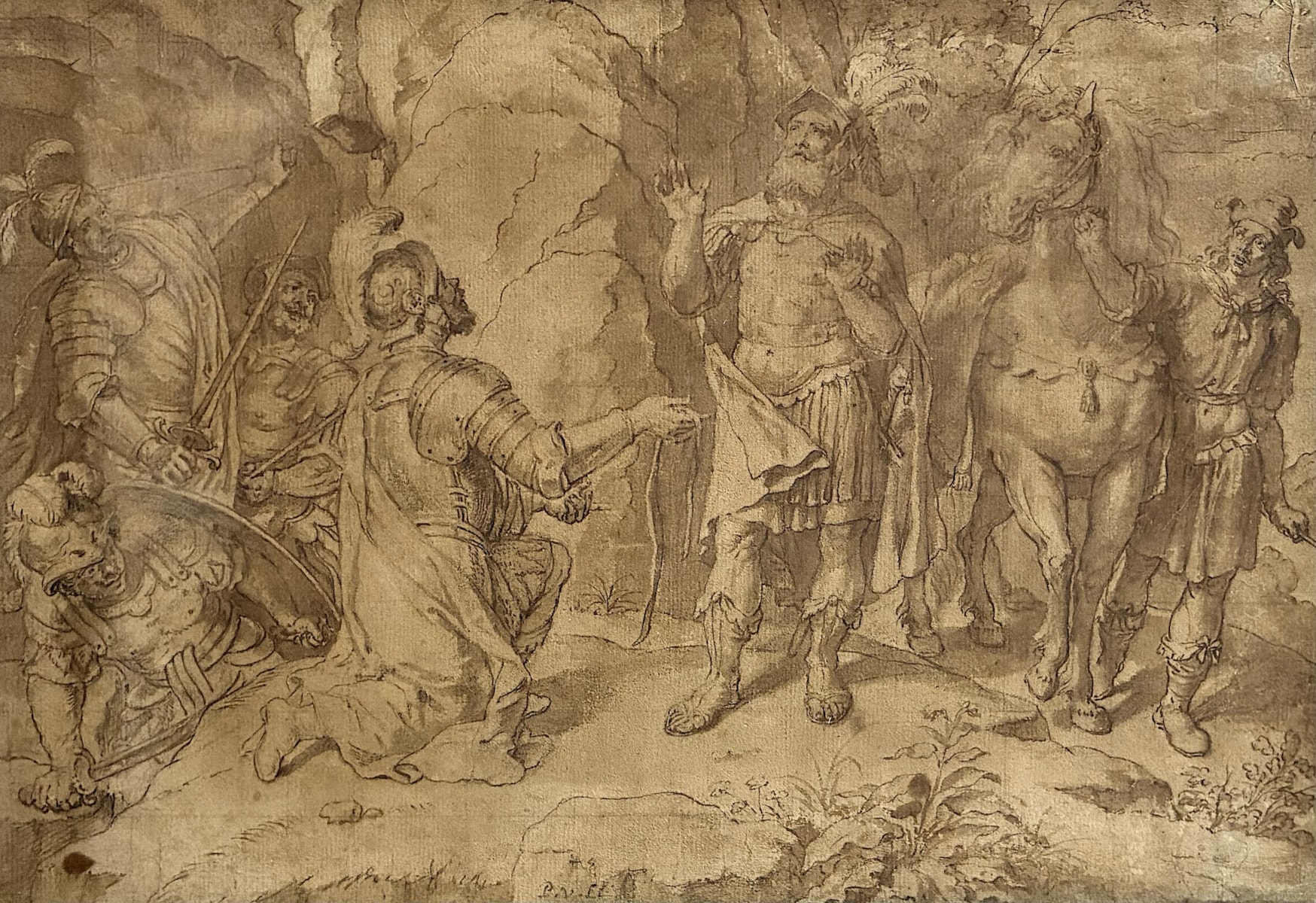
Peter van Lint (Antwerp 1609 - Antwerp 1690)
David spares King Saul's life in the cave of En Gedi
Description:
signed, lower centre: P.V.L.F
pen and brown ink and wash over black chalk, squared for transfer
310 x 450 mm
Provenance:
Private collection, near Rye, UK, since 1970s
Note:
This large and hitherto unpublished drawing by the Antwerp painter and tapestry designer Peter van Lint is a modello for a painting on copper. Dated to the 1640s, shortly after van Lint’s return from Rome to his native city, the whereabouts of the painting is currently unknown. Although van Lint was a significant representative of the Classical-Baroque movement, which rose to prominence in Flanders after the death of Peter Paul Rubens (1577–1640), he remains relatively understudied and poorly understood. Indeed, just 60 autograph drawings are listed in the artist’s catalogue raisonné, and the painting related to the present drawing was attributed to Jan Brueghel the Elder (1568–1625) as recently as 1993. Similarly, the subject of the painting was then mistaken for Charlemagne before the Death of Roland at Roncesvalles. Recently, the subject of the composition has been identified as David spares King Saul's life in the cave of En Gedi, and the painting has been recognised as belonging to a series of four works depicting scenes from the life of King David, two of which are in private collections and the third is in the Museum Abtei Liesborn in Wadersloh.
The narrative is drawn from the first Book of Samuel (1 Samuel 24). King Saul, afraid of the young David’s popularity, pursues him into the wilderness of En Gedi in the Judean Desert where he and his supporters have taken refuge. Passing by a cave, Saul enters to relieve himself, unaware of David’s presence. David forgoes the opportunity to kill his pursuer, and, unbeknownst to Saul, secretly cuts a piece of cloth from his robe. When Saul leaves the cave, David emerges to pay homage to the king, and demonstrate with the cloth that he holds no malice towards him. Weeping, Saul forgives David and recognizes him as successor to the Kingdom of Israel. Van Lint’s interpretation of the scene closely follows the biblical narrative, showing David and his supporters clad in armour to the left, and King Saul with his attendant to the right, looking to the heavens in penitence.
Please contact us for a full catalogue entry.