
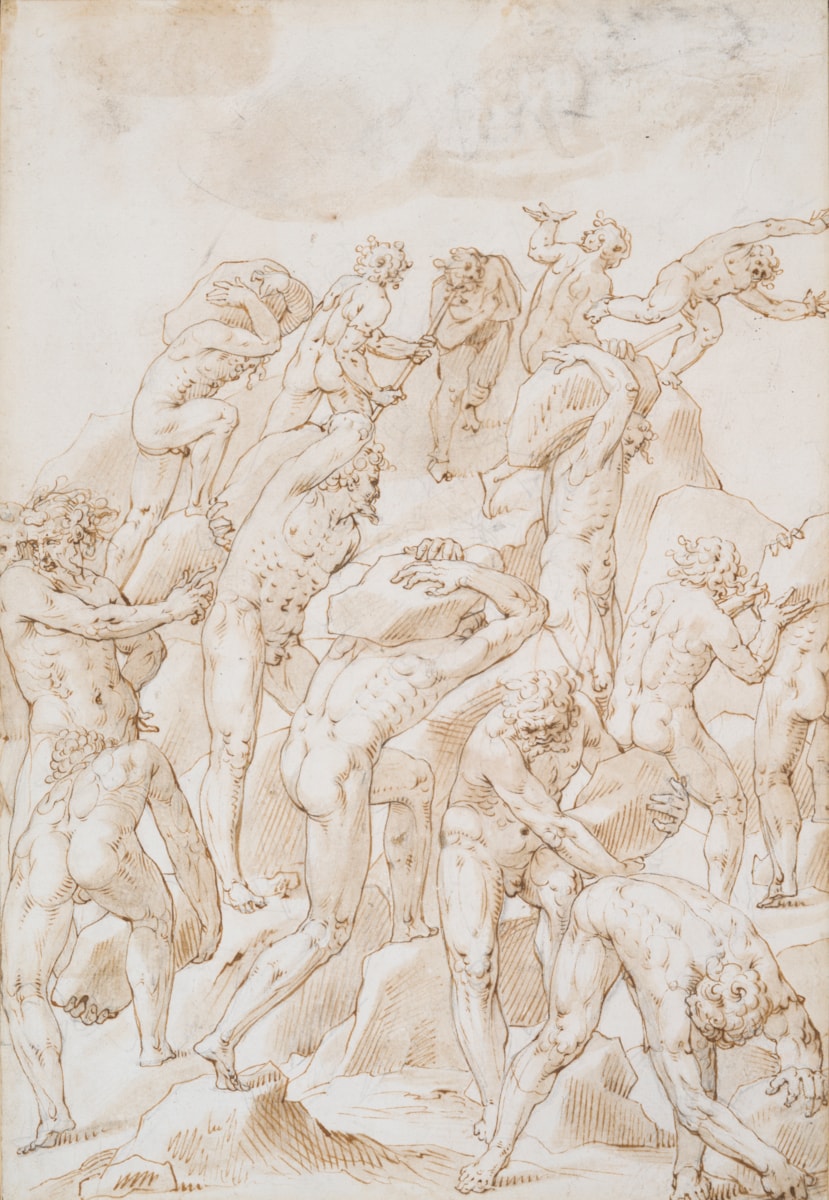
Northern School, c. 1600
The battle of the gods and the giants
Description:
pen and brown ink and wash over black chalk
414 x 288 mm
Provenance:
Victorien Sardou (1831–1908), Paris (his label on the frame)
Alphonse Daudet (1840–1897), Paris
By descent, Château de la Roche, Chargé
Their sale, Maître Gourdon, Touraine-Amboise: 9 June 1947 (according to label on verso)
Claudius Matthias de Jonge (1932–1993), Metz and Paris
His sale, ‘Collection C. de J’, Me Olivier Rieunier, Paris: 10 March 1986, lot 1 (as Gabriel Dreer)
Private collection, France
Rieunier et Bailly-Pommery, Paris: 28 April 1995, lot 57 (as Gabriel Dreer)
Private collection, France
Oger & Camper, Paris: 17 October 2011, lot 25 (as attributed to Gabriel Dreer)
Private collection, France
Literature
Frits Lugt, Les Marques de collections de dessins & d’estampes, updated May 2013 (as Gabriel Dreer)
Yvonne Bleyerveld, ‘Hans Speckaert, The battle between gods and giants, c. 1575, footnote 6’, Netherlandish Drawings of the Fifteenth and Sixteenth Centuries. Artists born before 1581, Online Collection Catalogue, Rotterdam (Museum Boijmans Van Beuningen), 2012 (as Gabriel Dreer)
Note:
This large mythological drawing depicts a scene from the Gigantomachy, the battle for supremacy over the cosmos between the Olympian gods and the giants (Ovid, Metamorphoses, I, 152–58). Here, the giants pile rocks to ascend to Olympus and mount their assault on the Olympian gods. On the basis of a perceived GD[F] monogram in the giant’s hair at lower right, the drawing has historically been attributed to the enigmatic Swabian painter Gabriel Dreer (c. 1580 – after 1636), although the incompatibility of comparable material renders such an attribution problematic.
Dr Wouter Kloek has indicated that the drawing is by a Northern follower of the influential Flemish artist Hans Speckaert (c. 1540 – c. 1577), possibly one who visited Rome in the later years of the sixteenth century, like Hendrik de Clerck (c. 1560–1630). Through the influence of Giulio Romano (1499–1546) and Romanists such as Speckaert and Frans Floris (c. 1519–1570), the Gigantomachy became a beloved subject for Netherlandish late Mannerist artists, as it offered the opportunity to depict a variety of muscular poses and figures in motion. Drawings of the Gigantomachy by Speckaert and his circle include a sheet attributed to Speckaert at the Museum Boijmans, and a sheet attributed to de Clerck at the Morgan Library & Museum. Further drawings of the type are in the Uffizi, and the Ashmolean Museum, while a contemporary drawing of the subject by Anthonie Blocklandt van Montfoort (c. 1533–1583) is in the Koninklijk Musea voor Schone Kunsten van België. Like the present drawing, the Boijmans sheet was formerly in the collection of Claudius Matthias de Jonge and was sold at auction in Paris in 1986.