
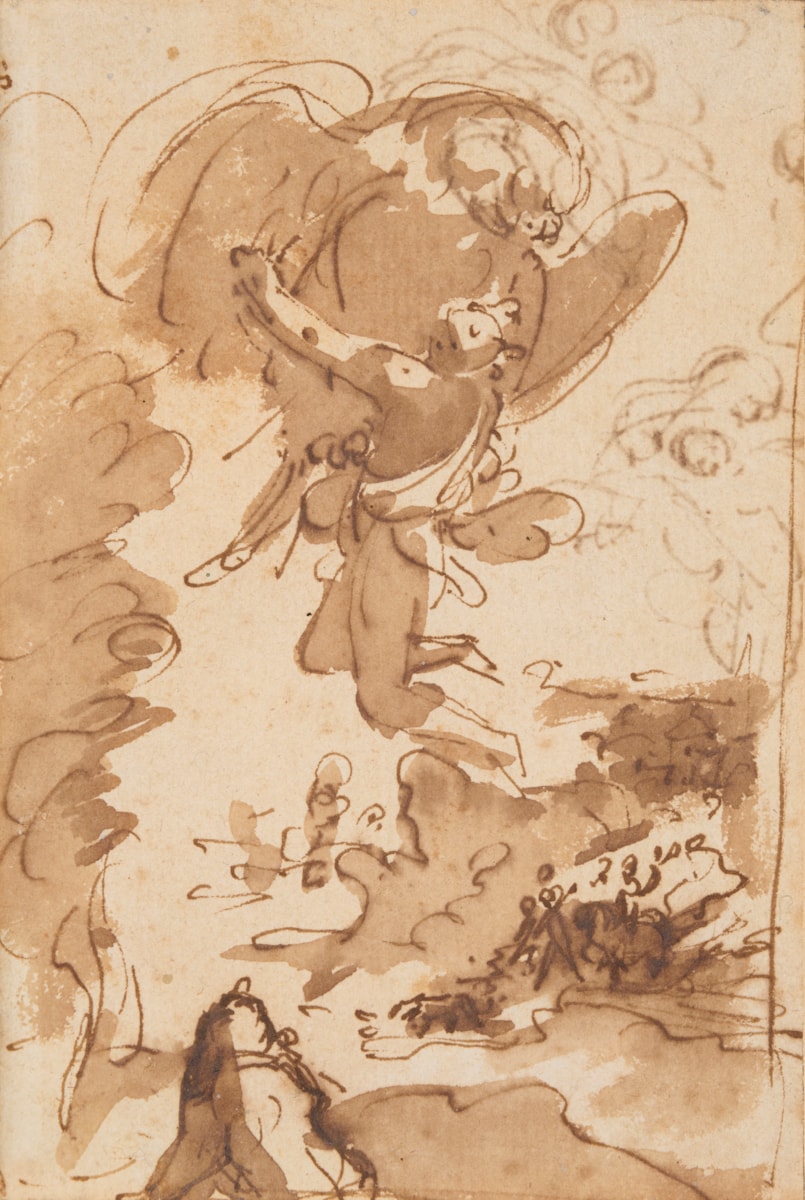
after Antonio Allegri, called Correggio (Correggio 1489 - Correggio 1534)
The abduction of Ganymede (recto); Airborne figures (verso)
Description:
pen and brown ink, brown wash
125 x 83 mm
Provenance:
Count Moritz von Fries (1777–1826), Vienna
Sir Thomas Lawrence (1769–1830), London
Samuel Woodburn (1783–1853), London, in 1834
King Willem II of the Netherlands (1792–1849), The Hague, in 1838 (as Correggio)
His sale, De Vries, Roos & Brondgees, The Hague: 12–20 August 1850, lot 90 (as Correggio)
Where acquired by Roos
C.G. Boerner, Leipzig: 19 June 1937, lot 320 (as Correggio)
C.G. Boerner, Leipzig: 28 April 1939, lot 368 (as Correggio)
Literature
Samuel and Allen Woodburn, The Lawrence Gallery. Fourth exhibition. A Catalogue of One Hundred Original Drawings by Il Parmigianino and Ant. A. Da Correggio, Collected by Sir Thomas Lawrence, London, 1836, no. 85 (as Correggio)
Note:
An early copy after Correggio’s late work The abduction of Ganymede, now at the Kunsthistorisches Museum in Vienna. The painting was commissioned around 1530 by Federico II Gonzaga as part of a series of four canvases concerning the loves of Jupiter. Two of the paintings, Ganymede and Jupiter and Io, subsequently entered the Spanish Royal Collection and in 1603 were given by Philip III to his cousin, the Emperor Rudolf II, and transferred to Vienna.
This small compositional study displays notable differences to the finished picture, particularly in the landscape background, suggesting that the drawing may derive from a lost drawing and thus provide significant documentary evidence regarding the composition’s earliest conception. Most significant of the changes is the group of onlookers, seen to the right of the drawing, who observe the airborne protagonists from afar. This group is redacted from Correggio’s ultimate composition, which affords greater space to the dog in the foreground and condenses the composition into a more vertical arrangement. Subtle changes are also made to the positioning of Ganymede’s right leg and to the landscape, which climbs diagonally to the right in the drawing, and to the left in the painting.
Sold