
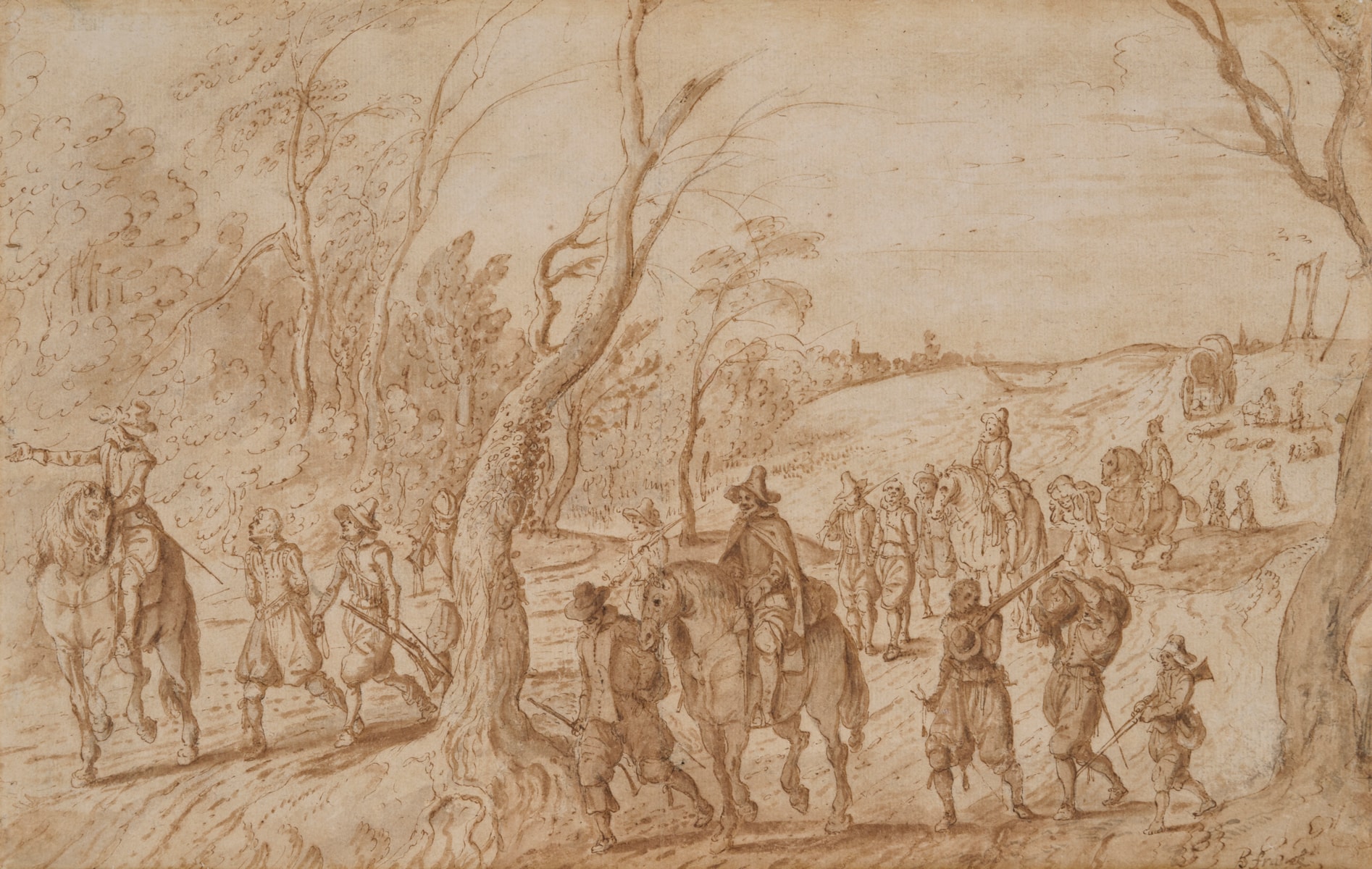
Sebastiaen Vrancx (Antwerp 1573 - 1647)
Highwaymen carrying away prisoners and booty
Description:
inscribed, lower right (recto): S. Franck; inscribed (verso): a a
pen and brown ink and brown and grey wash over traces of black chalk
229 x 362 mm
Provenance:
Dr Einar Perman (1893–1976), Stockholm
Private collection, Rye, New York
Literature
Dutch and Flemish Drawings in the Nationalmuseum and Other Swedish Collections, exh. cat. (Stockholm, Nationalmuseum, 1953), no. 92, pl. 18.
Oude Tekeningen uit de Nederlanden. Verzameling Prof. E. Perman, Stockholm, exh. cat. (Laren, Singer Museum, 1962), no. 145, pl. 21.
Exhibitions
Stockholm, Nationalmuseum, Dutch and Flemish Drawings in the Nationalmuseum and Other Swedish Collections, 1953, no. 92.
Laren, Singer Museum, Oude Tekeningen uit de Nederlanden. Verzameling Prof. E. Perman, Stockholm, 10 June 1962 – 16 September 1962, no. 145.
Note:
Brigandage and marauding were frequent realities in Flanders at the turn of the seventeenth century, shaped by the prolonged instability of the Eighty Years’ War (1568–1648) and, later, the Thirty Years’ War (1618–1648). The Flemish artist, Sebastiaen Vrancx, was intimately familiar with this martial culture, serving in the Antwerp civic militia and fully trained in swordsmanship. His depictions of military encounters and roadside skirmishes established an enduring model for such scenes in seventeenth-century Flemish art. The present drawing is a characteristic example of his subject matter, compositional structure, and graphic style.
With a monochrome palette, Vrancx depicts a company of highwaymen with their captured booty, escorting several wealthy, bound prisoners. On the hillside at right, the aftermath of the ambush unfolds: abandoned wagons and prone figures litter the road beneath the gallows, a pointed reminder of the dangers faced alike by robber and victim. To the left, a wood marks the brigands’ point of emergence, while a tall tree at right frames the composition. The delicate penwork, enriched by washes for depth and atmosphere, is wholly characteristic of Vrancx’s draughtsmanship. The sheet displays a heightened degree of individuality and anecdotal detail, evident in features such as the oversized firearm carried by the youth at lower right and the elaborate costumes of the prisoners. Comparable drawings are preserved in the collections of the Rijksmuseum, Amsterdam, and the Klassik Stiftung Weimar, Weimar.
Please contact us for a full catalogue entry.